

AI Operations Platform
A representative enterprise platform demonstrating how AI, automation and modern software engineering can transform business operations.
- Estimated timeline
- Typically 10–16 weeks for a first production module
- Platforms
- Web · Mobile · Cloud
- Tech stack
- Next.js · Node.js · PostgreSQL · OpenAI
The business scenario
A medium-to-large enterprise typically reaches a point where its operations run across a patchwork of spreadsheets, email threads, and disconnected internal tools — each department with its own process, none of them talking to each other. Reporting takes days instead of minutes. Documents live in scattered folders instead of a searchable system. Decisions wait on someone manually pulling numbers from three different places.
This Representative Solution demonstrates one possible architecture for solving that class of problem — an operations platform that centralizes workflow automation, document intelligence, and reporting behind a single, AI-assisted interface. It is not a real client deployment. It is a reference implementation showing the engineering approach, architectural decisions, and technology choices we would bring to a project like this.
The problems this platform responds to
The operational reality behind most enterprise software investments — not a single failure, but friction compounding across systems and teams.
How the platform addresses it
The platform centralizes operations behind a single interface — an AI assistant for everyday questions, workflow automation for repetitive processes, and a knowledge base that makes institutional information actually searchable, all backed by real-time analytics and reporting.

AI Assistant

Workflow Automation
Knowledge Base

Analytics
Reporting

Notifications

Role Permissions
Document Intelligence
What's included
The feature set that makes the solution overview concrete — each one a real, scoped piece of the platform, not a roadmap aspiration.
How the system is structured
A layered architecture separating presentation, orchestration, business logic, and AI services from the data and infrastructure layers beneath them — each layer independently scalable and independently testable.
- 01
Frontend
The web and mobile client applications operators and administrators interact with directly.
Next.jsReactReact Native - 02
API Gateway
A single entry point handling authentication, rate limiting, and request routing to the services behind it.
AuthRate limitingRouting - 03
Application Layer
The core business logic — workflows, approvals, permissions — implemented as independently deployable services.
Node.jsLaravel - 04
AI Services
A dedicated layer orchestrating LLM calls for search, document processing, and the assistant interface.
OpenAIClaudeLLM orchestration - 05
Database
The system of record for operational data, structured for the query patterns the platform actually runs.
PostgreSQLRedis - 06
Storage
Object storage for uploaded documents and media, decoupled from the application database.
AWS S3DocumentsMedia - 07
Monitoring
Logging, error tracking, and health checks across every layer, so issues surface before they affect operations.
LoggingAlertsHealth checks - 08
Analytics
A metrics pipeline feeding the platform's reporting and dashboards from the same underlying event data.
Metrics pipelineReporting
Built on a modern, production-grade stack
Every technology here is a deliberate choice, not a default.
How we approached the build
- Architecture First
The layered architecture — frontend, gateway, application, AI services, data — was defined before any feature code was written, not discovered along the way.
- Modular Services
Each application-layer service is independently deployable, so one module's release cycle never blocks another's.
- Security by Default
Role-based access control and data encryption are enforced at the data layer, not bolted onto the interface after the fact.
- Long-term Maintainability
Clear service boundaries and documented architecture mean a new engineer can understand and extend one module without needing to understand the whole system first.
What this architecture is designed to achieve
This kind of platform is designed to change how an operations team works day to day — not to hit a specific number, but to remove the friction that makes the current way of working slow.
Reduced repetitive work, as approvals, data entry, and status updates move from manual to automated.
Improved operational visibility, with leadership able to see real-time status instead of asking each team individually.
Centralised business information, replacing scattered spreadsheets and folders with one searchable system.
Faster internal processes, as workflows that once required multiple handoffs run through a single automated path.
Better decision support, with the AI assistant and reporting layer surfacing relevant data at the moment it's needed.
Improved scalability, since the modular architecture lets the platform grow by adding services, not rebuilding them.
Frequently asked questions
More representative solutions
Other reference architectures from the same Representative Solutions collection.
Business Automation Suite
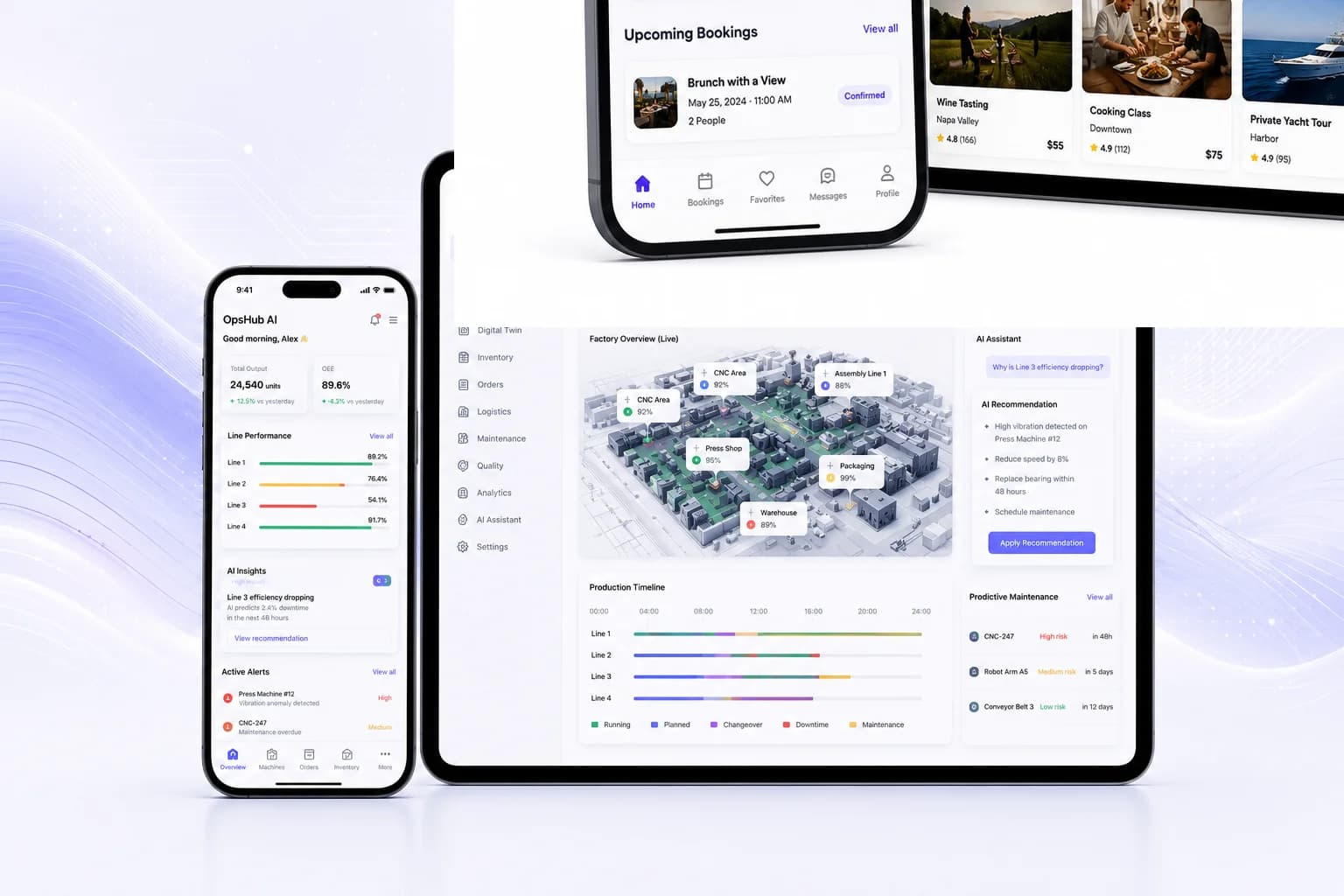
Manufacturing Control Center
Enterprise CRM
Customer Support AI
Technologies we build this on
The stack pieces most relevant to a project like this one.
Node.js Development
We build enterprise backend systems with Node.js — REST APIs, real-time applications, and event-driven microservices architected for concurrency, scalability, and high availability.
Explore the stackOpenAI Integration
We integrate OpenAI models into enterprise software — AI assistants, retrieval-augmented search, and document intelligence architected for accuracy, cost control, and production reliability.
Explore the stackPostgreSQL Development
We design and operate PostgreSQL databases for enterprise software — schema design, replication, and partitioning architected around the domain's actual data integrity and scale requirements, not a generic reference schema.
Explore the stackServices that pair with this work
Other engineering disciplines projects like this one often need alongside it.
AI Development
We design and build production-ready AI systems, LLM integrations, AI agents, RAG platforms, workflow automation and intelligent business software.
Explore the serviceBusiness Automation
Automate repetitive processes, connect disconnected systems and eliminate manual work through intelligent workflows, integrations and AI-powered automation.
Explore the serviceCustom Software Development
We design and build custom business software engineered around your operations, not adapted from off-the-shelf products.
Explore the serviceRelated reading
Practical guides worth reading while you're scoping this kind of project.
How to Build AI Agents for Enterprise Software
An AI agent extends a large language model with reasoning, memory, and the ability to call tools and take real actions inside business systems — this guide explains how agents are actually architected, deployed, and governed in production, not the marketing version of what an agent is.
Read the guideAI Agents vs. Chatbots: An Enterprise Comparison Guide
A traditional chatbot follows scripted rules or intent-matched responses within a fixed conversation flow. An AI agent uses a large language model to reason, plan, call tools, and take multi-step action toward a goal. This guide compares them directly — architecture, cost, governance, and the enterprise use cases where each is actually the better engineering choice — remaining vendor-neutral throughout.
Read the guidePrompt Engineering for Enterprise AI: A Practical Engineering Guide
Prompt engineering is the discipline of designing, structuring, and governing the inputs sent to a large language model — system prompts, context, tool definitions, output format — so its behavior is reliable, testable, and maintainable in production. This guide explains how prompt engineering is actually implemented, versioned, evaluated, and secured in enterprise AI systems, not a collection of clever one-off phrasings.
Read the guidePurpose-built platforms in this space
Dedicated landing pages for the specific platforms we build most often.
Manufacturing Software Development Company
Industrial software and smart factory platforms that improve production efficiency and visibility.
See the solutionLogistics Software Development Company
Logistics platforms, transportation software, and supply chain solutions built for operational visibility.
See the solutionAI Development Company in South Korea
Enterprise AI software, LLM integrations, and AI agents built for Korean and international companies.
See the solutionFor CTOs and technical leadership
Executive-level engagements for organisations planning at a larger scale.
Digital Transformation Consulting Services
Helping enterprise leaders modernise legacy systems and build digital products through disciplined engineering.
Explore the programAI Strategy Consulting for Enterprise Leaders
Helping organisations identify, prioritise, and implement AI initiatives that generate measurable value.
Explore the programLet's engineer your next intelligent platform.
Whether you're automating internal operations, building an AI assistant, or modernising a legacy system, we'll help you architect it right.
No sales pressure. Just a direct technical conversation.