

Smart Logistics Hub
A representative logistics platform engineered to centralise fleet operations, warehouse management, shipment tracking and supply chain visibility into one scalable cloud-native ecosystem.
- Estimated timeline
- Typically 10–16 weeks for a first production module
- Platforms
- Web · Mobile · Cloud
- Tech stack
- Next.js · Laravel · PostgreSQL · Google Maps
The business scenario
A logistics company running its own fleet, warehouses, and delivery operations typically ends up managing each of them through a different tool — fleet positions tracked in one system, warehouse stock in another, and customers calling in for a shipment status nobody can answer without checking three separate places. Dispatch decisions are made from whatever information happens to be current at the moment, not from a live picture of the whole operation.
This Representative Solution demonstrates one possible architecture for solving that class of problem — a cloud-native platform that centralises fleet operations, warehouse management, shipment tracking, and customer communication behind a single operational environment, with live vehicle position and route data flowing in continuously rather than being checked manually. It is not a real client deployment. It is a reference implementation showing the engineering approach we would bring to a logistics project like this.
The problems this platform responds to
The operational reality behind most enterprise software investments — not a single failure, but friction compounding across systems and teams.
How the platform addresses it
The platform centralizes logistics operations behind a single environment — real-time fleet and shipment visibility, warehouse operations connected to the same data model, and a dispatch centre that plans routes from live conditions instead of static assumptions, with dedicated views for customers and drivers.

Fleet Dashboard

Warehouse Management

Shipment Tracking

Customer Portal

Driver Mobile App

Analytics

Dispatch Centre

Business Intelligence
What's included
The feature set that makes the solution overview concrete — each one a real, scoped piece of the platform, not a roadmap aspiration.
How the system is structured
A layered architecture connecting the web dashboard and mobile apps to live GPS and fleet data, with dedicated services for location tracking separated from core business logic.
- 01
Web Dashboard
The web and mobile interfaces operators, dispatchers, drivers, and customers interact with directly.
Next.jsReactReact Native - 02
API Gateway
A single entry point handling authentication, rate limiting, and request routing to the services behind it.
AuthRate limitingRouting - 03
Business Services
The core business logic — fleet management, warehouse operations, dispatch, shipment tracking — as independently deployable services.
Node.jsLaravel - 04
GPS Services
A dedicated layer ingesting live vehicle location and route data, decoupled from the core business services.
Google MapsMapboxLive tracking - 05
Database
The system of record for fleet, warehouse, and shipment data, structured for the query patterns the platform runs.
PostgreSQLRedis - 06
Notifications
Real-time alerts to operators, drivers, and customers, delivered through push, SMS, and email.
FirebasePushSMS/Email - 07
Analytics
A metrics pipeline feeding operational reporting and dashboards from the same underlying event data.
Metrics pipelineReporting - 08
Monitoring
Logging, error tracking, and health checks across every layer, so issues surface before they affect deliveries.
LoggingAlertsHealth checks
Built on a modern, production-grade stack
Every technology here is a deliberate choice, not a default.
How we approached the build
- Real-time Architecture
Fleet position, shipment status, and dispatch decisions all depend on data that's seconds old, not minutes. The architecture is built around continuous data flow, not periodic polling.
- Reliable Integrations
GPS, mapping, and notification integrations are built to keep working as each connected provider changes, not tightly coupled to any single vendor's API.
- Scalable Operations
Adding a new warehouse or region means adding capacity, not re-architecting how the platform ingests and processes fleet data.
- Long-term Maintainability
Clear service boundaries mean a new engineer can understand and extend one module — dispatch, warehouse, tracking — without needing to understand the entire platform first.
What this architecture is designed to achieve
This kind of platform is designed to change how a logistics operation runs day to day — not to hit a specific number, but to remove the blind spots that make dispatch, warehouse coordination, and customer communication reactive instead of planned.
Real-time operational visibility, with live fleet and shipment status in one place instead of checking multiple systems.
Improved fleet coordination, as dispatch decisions are made from live vehicle and route data instead of static assumptions.
Centralised warehouse operations, replacing separate stock-tracking tools with one connected data model.
Better customer communication, with shipment status available directly instead of requiring a support call.
Scalable logistics platform, since the modular architecture lets new warehouses, regions, and fleets be added without a rebuild.
Frequently asked questions
More representative solutions
Other reference architectures from the same Representative Solutions collection.
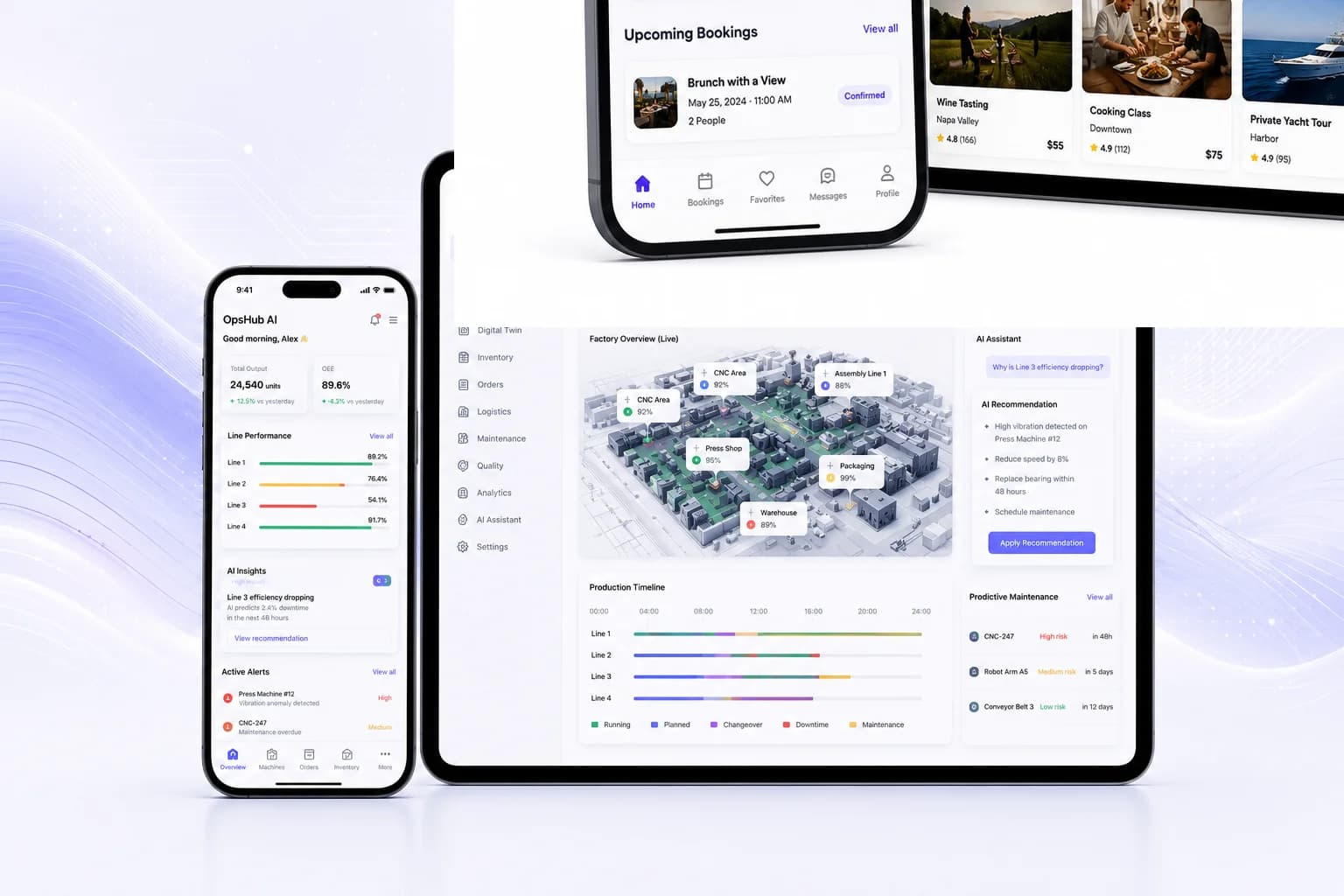
Manufacturing Control Center
Business Automation Suite

Enterprise CRM
AI Operations Platform
Technologies we build this on
The stack pieces most relevant to a project like this one.
React Native Development
We build high-performance cross-platform mobile applications using React Native, delivering native experiences for iOS and Android from a shared codebase.
Explore the stackNode.js Development
We build enterprise backend systems with Node.js — REST APIs, real-time applications, and event-driven microservices architected for concurrency, scalability, and high availability.
Explore the stackPostgreSQL Development
We design and operate PostgreSQL databases for enterprise software — schema design, replication, and partitioning architected around the domain's actual data integrity and scale requirements, not a generic reference schema.
Explore the stackServices that pair with this work
Other engineering disciplines projects like this one often need alongside it.
AI Development
We design and build production-ready AI systems, LLM integrations, AI agents, RAG platforms, workflow automation and intelligent business software.
Explore the serviceBusiness Automation
Automate repetitive processes, connect disconnected systems and eliminate manual work through intelligent workflows, integrations and AI-powered automation.
Explore the serviceMobile App Development
Aixo Lab designs and builds native iOS, native Android, and cross-platform mobile applications, from architecture through App Store and Play Store release.
Explore the serviceRelated reading
Practical guides worth reading while you're scoping this kind of project.
API-First Architecture for Enterprise Software
API-first architecture means designing and agreeing on an API's contract before writing the implementation behind it, so every client — web, mobile, partner integrations, AI systems — builds against a stable interface instead of whatever the backend happens to expose. This guide explains how that discipline is actually applied in enterprise systems, not the marketing version of the idea.
Read the guideDatabase Design for Enterprise Applications: A Practical Engineering Guide
Database design for enterprise applications is the discipline of structuring data models, schemas, and infrastructure so a system stays correct, fast, and maintainable as both the application and the organization grow. It covers relational and non-relational modeling, normalization and denormalization trade-offs, indexing and query performance, and the scaling patterns — partitioning, replication, caching — that keep a database healthy at real production load. Good database design is invisible when done well and expensive to fix when done poorly, which is why it deserves the same engineering rigor as any other part of the system.
Read the guideHow to Build AI Agents for Enterprise Software
An AI agent extends a large language model with reasoning, memory, and the ability to call tools and take real actions inside business systems — this guide explains how agents are actually architected, deployed, and governed in production, not the marketing version of what an agent is.
Read the guidePurpose-built platforms in this space
Dedicated landing pages for the specific platforms we build most often.
Logistics Software Development Company
Logistics platforms, transportation software, and supply chain solutions built for operational visibility.
See the solutioniOS & Android Mobile App Development Company
Native and cross-platform mobile apps — iOS, Android, and React Native — for startups and enterprises.
See the solutionFor CTOs and technical leadership
Executive-level engagements for organisations planning at a larger scale.
Let's engineer your next logistics platform.
Whether you're centralising fleet and warehouse operations, building real-time shipment tracking, or modernising legacy dispatch systems, we'll help you architect it right.
No sales pressure. Just a direct technical conversation.