

Smart Warehouse Management System
A cloud-based warehouse platform that combines inventory management, barcode scanning, AI-assisted forecasting, and real-time logistics visibility across multiple facilities.
- Estimated timeline
- Typically 12–18 weeks for a first production module
- Platforms
- Web · Mobile · Cloud
- Tech stack
- Next.js · Laravel · OpenAI · Barcode SDK
The business scenario
Warehouse operations get complex fast once a business runs more than one facility. Inventory counts drift from what's actually on the shelf, receiving and picking run on paper or disconnected spreadsheets, and a delayed shipment often isn't visible until a customer asks where their order is. Distributors, manufacturers, retailers, and logistics providers all hit the same wall — the tools meant to track stock stop being trustworthy exactly when the business needs them most, at scale and across locations.
This Representative Solution demonstrates one possible architecture for solving that class of problem — a cloud-based warehouse platform that unifies inventory control, barcode-driven receiving and picking, and AI-assisted demand forecasting behind a single system of record. Every scan, transfer, and cycle count updates the same inventory engine in real time, so accuracy holds even as operations scale across multiple warehouses. AI forecasting predicts demand from real movement history rather than static reorder points, and the platform is built to synchronize with existing ERP systems instead of replacing them outright. It is not a real client deployment. It is a reference implementation showing the engineering approach we would bring to a warehouse management project like this.
The problems this platform responds to
The operational reality behind most enterprise software investments — not a single failure, but friction compounding across systems and teams.
How the platform addresses it
The platform centralizes warehouse operations behind a single cloud system — an inventory engine that stays accurate in real time, barcode-driven workflows for every physical movement, and AI forecasting that turns movement history into a demand signal.

Cloud Warehouse Platform

Inventory Engine
Barcode Management
Receiving & Putaway
Picking & Packing

Shipping & Returns

AI Forecasting
Mobile Warehouse App
What's included
The feature set that makes the solution overview concrete — each one a real, scoped piece of the platform, not a roadmap aspiration.
How the system is structured
A layered architecture routing every physical scan through a dedicated inventory engine, with AI forecasting and ERP synchronization as their own services rather than logic buried inside the application layer.
- 01
Mobile Scanner
Handheld and mobile devices on the warehouse floor — the entry point for every physical inventory event.
Barcode SDKOffline syncMobile - 02
Warehouse API
A single entry point handling authentication, request routing, and rate limiting for every client.
AuthRate limitingRouting - 03
Business Services
Core warehouse logic — receiving, picking, packing, transfers — as independently deployable services.
Node.jsLaravel - 04
Inventory Engine
The dedicated system of record for stock levels, updated atomically by every scan and transaction.
PostgreSQLRedis - 05
AI Forecast Engine
A dedicated service turning historical movement data into demand predictions for every SKU and location.
OpenAIForecasting models - 06
ERP Integration
A synchronization layer keeping external ERP systems and the warehouse platform's inventory in agreement.
REST APIsWebhooks - 07
Database
The system of record for inventory, orders, and warehouse data, structured for the query patterns the platform runs.
PostgreSQLRedis - 08
Analytics
A metrics pipeline feeding warehouse dashboards and reporting from the same underlying event data.
Metrics pipelineReporting
Built on a modern, production-grade stack
Every technology here is a deliberate choice, not a default.
How we approached the build
- Inventory Consistency
Every stock-affecting action goes through the inventory engine as a single, atomic source of truth — never a client-side estimate reconciled later.
- Offline-first Scanning
The mobile app queues scans locally and syncs when connectivity returns, so a weak warehouse signal never stops the floor from working.
- Real-time Synchronization
Stock levels update across every warehouse and connected system the moment a scan happens, not on a batch schedule.
- ERP Integration Ready
The platform is built to synchronize with existing ERP systems from day one, not bolted on after as a separate integration project.
- Scalable Warehouse Operations
The data model and service boundaries are designed to hold up as facility count and order volume grow, not just at pilot scale.
What this architecture is designed to achieve
This kind of platform is designed to change how a warehouse operates day to day — not to hit a specific number, but to remove the friction that makes inventory accuracy, picking efficiency, and multi-facility coordination harder to manage than they need to be.
Better inventory accuracy, with stock levels reflecting what's actually on the shelf instead of drifting over time.
Faster warehouse operations, as receiving, picking, and packing run through one coordinated, scan-driven workflow.
Lower picking errors, with barcode verification catching mismatches before an order ever ships.
Improved shipment speed, since orders move from pick to carrier handoff without manual handoffs slowing things down.
Centralized stock visibility, replacing per-warehouse spreadsheets with one real-time view across every facility.
Better forecasting, with demand predictions grounded in real movement history instead of static reorder points.
Frequently asked questions
More representative solutions
Other reference architectures from the same Representative Solutions collection.
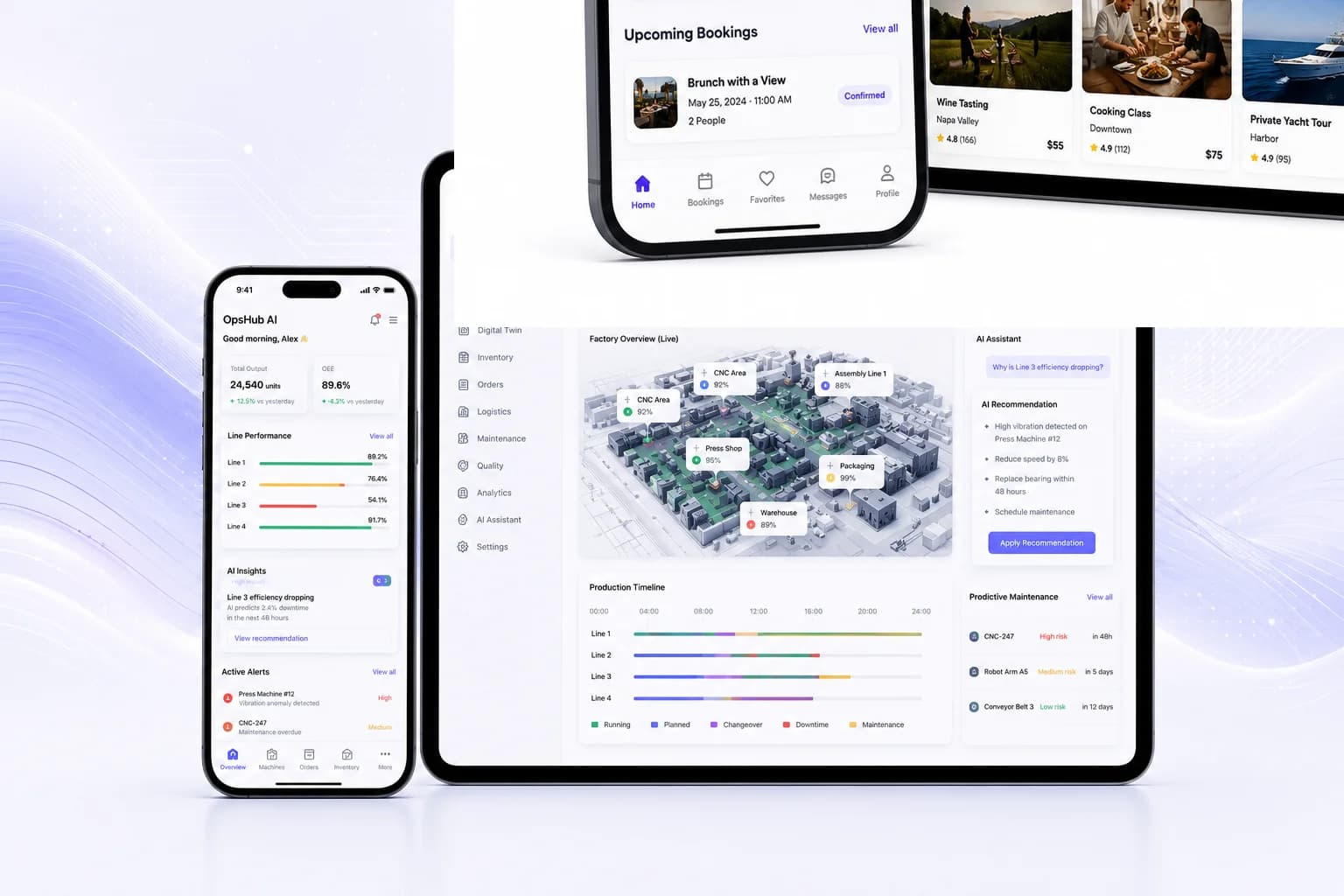
Manufacturing Control Center
Enterprise CRM
Business Automation Suite
AI Operations Platform
Technologies we build this on
The stack pieces most relevant to a project like this one.
Node.js Development
We build enterprise backend systems with Node.js — REST APIs, real-time applications, and event-driven microservices architected for concurrency, scalability, and high availability.
Explore the stackPostgreSQL Development
We design and operate PostgreSQL databases for enterprise software — schema design, replication, and partitioning architected around the domain's actual data integrity and scale requirements, not a generic reference schema.
Explore the stackREST API Development
We design and build enterprise REST APIs — resource modeling, authentication, versioning, and rate limiting architected as long-term contracts, not endpoints assembled to make one client work.
Explore the stackServices that pair with this work
Other engineering disciplines projects like this one often need alongside it.
Custom Software Development
We design and build custom business software engineered around your operations, not adapted from off-the-shelf products.
Explore the serviceAI Development
We design and build production-ready AI systems, LLM integrations, AI agents, RAG platforms, workflow automation and intelligent business software.
Explore the serviceBusiness Automation
Automate repetitive processes, connect disconnected systems and eliminate manual work through intelligent workflows, integrations and AI-powered automation.
Explore the serviceRelated reading
Practical guides worth reading while you're scoping this kind of project.
Database Design for Enterprise Applications: A Practical Engineering Guide
Database design for enterprise applications is the discipline of structuring data models, schemas, and infrastructure so a system stays correct, fast, and maintainable as both the application and the organization grow. It covers relational and non-relational modeling, normalization and denormalization trade-offs, indexing and query performance, and the scaling patterns — partitioning, replication, caching — that keep a database healthy at real production load. Good database design is invisible when done well and expensive to fix when done poorly, which is why it deserves the same engineering rigor as any other part of the system.
Read the guideAPI-First Architecture for Enterprise Software
API-first architecture means designing and agreeing on an API's contract before writing the implementation behind it, so every client — web, mobile, partner integrations, AI systems — builds against a stable interface instead of whatever the backend happens to expose. This guide explains how that discipline is actually applied in enterprise systems, not the marketing version of the idea.
Read the guideHow to Build AI Agents for Enterprise Software
An AI agent extends a large language model with reasoning, memory, and the ability to call tools and take real actions inside business systems — this guide explains how agents are actually architected, deployed, and governed in production, not the marketing version of what an agent is.
Read the guidePurpose-built platforms in this space
Dedicated landing pages for the specific platforms we build most often.
Logistics Software Development Company
Logistics platforms, transportation software, and supply chain solutions built for operational visibility.
See the solutionManufacturing Software Development Company
Industrial software and smart factory platforms that improve production efficiency and visibility.
See the solutionFor CTOs and technical leadership
Executive-level engagements for organisations planning at a larger scale.
Build your next warehouse management platform.
Whether you're unifying inventory across facilities, adding AI-assisted forecasting, or connecting barcode operations to an existing ERP, we'll help you architect it right.
No sales pressure. Just a direct technical conversation.