

Legacy Software Modernization
Modernise legacy applications with a structured engineering approach that improves performance, scalability and long-term maintainability while reducing operational risk.
- Engineering-First
- Scalable Cloud Platforms
- Modern UX
- AI Integration
- Long-Term Maintainability
- Estimated timeline
- Typically 8–12 weeks for an initial assessment and modernisation roadmap
- Platforms
- Legacy Systems · Cloud Platforms · APIs
- Tech stack
- React · Next.js · Node.js · PostgreSQL
The real cost of an unmodernised system
A legacy system doesn't fail on a single day — it accumulates risk quietly, until a security incident, an outage, or a missed opportunity makes the cost impossible to ignore. Modernisation isn't about replacing what works; it's about addressing the specific risks a system has accumulated before they become the business's problem to solve under pressure.
- Technical Debt
Accumulated shortcuts and deferred fixes that make every new feature slower and riskier to ship than it should be.
- Security
Unpatched dependencies and outdated frameworks that widen the attack surface with every year the system goes unmodernised.
- Scalability
Architecture that worked at a smaller scale, now a direct constraint on the business's ability to grow.
- Maintenance Costs
A growing share of engineering budget spent keeping an old system running, rather than building what the business actually needs next.
The problems that show up first
The specific, day-to-day symptoms that tend to surface before a legacy system becomes a strategic risk.
The right strategy depends on the system, not a default playbook
Every modernisation engagement starts by matching the actual constraint to the right strategy, not applying the same approach to every system.
Choosing the right modernisation approach
The right approach depends on the system's role in the business, not a default preference for one over the other.
| Dimension | Incremental Modernization | Full Rewrite |
|---|---|---|
| Business Risk | Lower — changes are shipped in small, reversible increments alongside the existing system. | Higher — the business depends on the legacy system until the full rewrite reaches parity. |
| Timeline to First Value | Weeks — the first modernised component can ship early and start delivering value. | Months to years — value is only realised once the rewrite reaches feature parity. |
| Business Continuity | Maintained throughout — the legacy system keeps running until each piece is replaced. | At risk during the transition — the business runs on two systems, or none, until cutover. |
| Cost Predictability | More predictable — cost is scoped per increment and adjusted as priorities change. | Less predictable — scope tends to grow before the rewrite reaches parity with the original system. |
| Team Disruption | Lower — the existing team keeps shipping while modernisation happens in parallel. | Higher — most engineering capacity is committed to the rewrite until it ships. |
| Best Fit | Systems still core to the business, where continuity and reduced risk matter most. | Systems where the underlying architecture is fundamentally incompatible with where the business needs to go. |
Where AI genuinely accelerates a modernisation programme
AI applied to the specific, high-effort tasks that slow a modernisation programme down, not adopted for its own sake.
Built on a modern, production-grade stack
Every technology here is a deliberate choice, not a default — selected for the specific system it replaces or extends.
Why enterprise leaders trust Aixo Lab with legacy modernisation
- Engineering-First Mindset
Every modernisation engagement starts with a real assessment of the existing system's architecture and constraints, not a predetermined rebuild recommendation.
- Incremental Delivery
Modernisation delivered in shippable increments that reduce risk and start delivering value early, not a single high-risk cutover.
- Risk Reduction
Business continuity treated as a first-class constraint throughout the engagement, not an afterthought to the technical plan.
- Scalable Architecture
Systems designed to handle real growth, built for where the business is headed rather than just replacing what exists today.
- Long-Term Maintainability
We design for the team that maintains this system in two years, including when that's your own in-house engineers — documentation and handover are part of the deliverable.
- Transparent Communication
Direct access to the engineers doing the modernisation work, with visible progress throughout — not a project manager relaying status secondhand.
Frequently asked questions
Technologies behind our modernisation work
The specific stack choices referenced throughout this page, explained in more technical depth.
Next.js Development
We build enterprise-grade web applications with Next.js, combining the App Router, Server Components, and hybrid rendering to ship products that are fast, scalable, and built to grow.
See the technical detailsLaravel Development
We build enterprise backend systems with Laravel — custom APIs, business software, and SaaS platforms architected for security, scalability, and long-term maintainability.
See the technical detailsNode.js Development
We build enterprise backend systems with Node.js — REST APIs, real-time applications, and event-driven microservices architected for concurrency, scalability, and high availability.
See the technical detailsPostgreSQL Development
We design and operate PostgreSQL databases for enterprise software — schema design, replication, and partitioning architected around the domain's actual data integrity and scale requirements, not a generic reference schema.
See the technical detailsDocker Development
We containerize enterprise software with Docker as a deliberate engineering discipline — image builds, networking, volumes, and secrets designed for a specific production environment, not a development convenience left unchanged at deploy time.
See the technical detailsServices that pair with legacy modernisation
Modernisation programmes rarely stand alone — these are the adjacent engagement types most modernisation programmes connect to.
Custom Software Development
We design and build custom business software engineered around your operations, not adapted from off-the-shelf products.
Explore this serviceBusiness Automation
Automate repetitive processes, connect disconnected systems and eliminate manual work through intelligent workflows, integrations and AI-powered automation.
Explore this serviceAI Development
We design and build production-ready AI systems, LLM integrations, AI agents, RAG platforms, workflow automation and intelligent business software.
Explore this serviceWhat this looks like once modernised
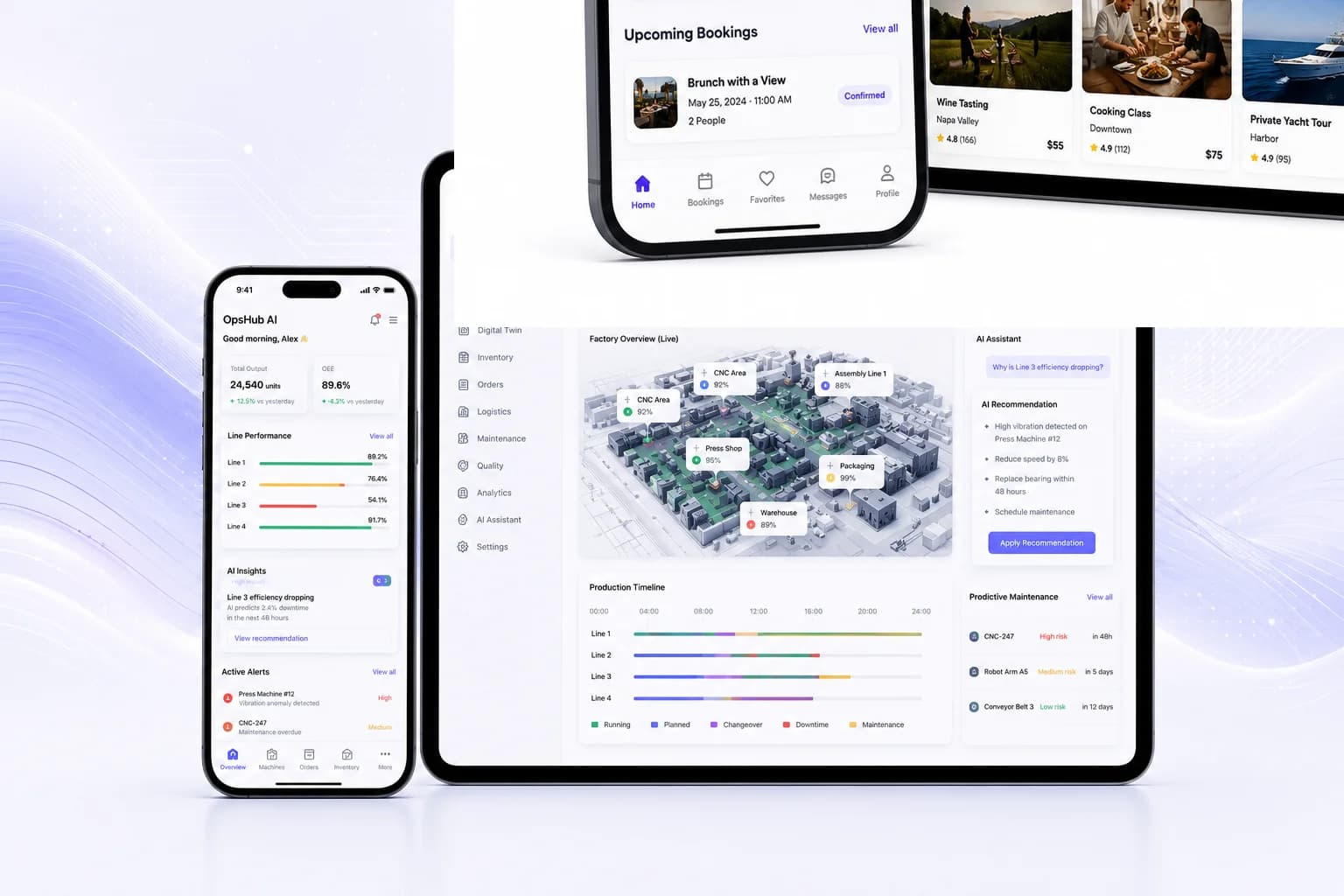
Reference architectures from our Representative Solutions collection that show these ideas in practice.
Further reading on enterprise architecture
In-depth engineering guides that go deeper on the specific technical decisions referenced throughout this page.
API-First Architecture for Enterprise Software
API-first architecture means designing and agreeing on an API's contract before writing the implementation behind it, so every client — web, mobile, partner integrations, AI systems — builds against a stable interface instead of whatever the backend happens to expose. This guide explains how that discipline is actually applied in enterprise systems, not the marketing version of the idea.
Read the guideDatabase Design for Enterprise Applications: A Practical Engineering Guide
Database design for enterprise applications is the discipline of structuring data models, schemas, and infrastructure so a system stays correct, fast, and maintainable as both the application and the organization grow. It covers relational and non-relational modeling, normalization and denormalization trade-offs, indexing and query performance, and the scaling patterns — partitioning, replication, caching — that keep a database healthy at real production load. Good database design is invisible when done well and expensive to fix when done poorly, which is why it deserves the same engineering rigor as any other part of the system.
Read the guideSaaS Architecture: A Practical Engineering Guide for Enterprise Platforms
SaaS architecture is the set of engineering decisions that let a single codebase and infrastructure serve many customer organizations reliably, securely, and cost-effectively — multi-tenancy strategy, authentication and authorization, billing and subscription systems, and the scalability and security patterns that hold up under real enterprise load. It's not one specific stack or diagram; it's a set of trade-offs a team makes deliberately, based on the product's actual tenant count, compliance requirements, and growth trajectory, rather than copying whatever architecture a well-known SaaS company happens to use.
Read the guideThe platforms legacy systems get modernised into
Companies replacing an ageing core system usually land on one of these — custom-built, not off-the-shelf, and engineered on modern architecture.
Custom ERP Software Development Company
Custom ERP platforms that centralise operations and connect every department on one scalable system.
See the solutionCustom Software Development Company
Enterprise systems, CRMs, ERPs, and internal tools tailored to how your operation actually runs.
See the solutionManufacturing Software Development Company
Industrial software and smart factory platforms that improve production efficiency and visibility.
See the solutionOther ways we work with enterprise leadership
Modernisation is usually one part of a larger programme — see how it connects to the other consulting engagements we offer.
Digital Transformation Consulting Services
Helping enterprise leaders modernise legacy systems and build digital products through disciplined engineering.
Explore the engagementSoftware Architecture Consulting Services
Scalable, secure, and maintainable software architecture designed to support long-term business growth.
Explore the engagementAI Strategy Consulting for Enterprise Leaders
Helping organisations identify, prioritise, and implement AI initiatives that generate measurable value.
Explore the engagementReady to modernise your legacy system?
Tell us about your system and constraints — we'll tell you honestly what it would take to modernise it properly.
No sales pressure. Just a direct engineering conversation.